
Once you have picked a stone, you still have to pick a finish, and that choice changes how the countertop looks and lives every single day.
Leathered granite has become one of the most requested options in Central Florida kitchen remodels because it hides the fingerprints, water spots and smudges that make a polished slab look dirty an hour after you wipe it.
This guide compares all three stone finishes (polished, honed and leathered) side by side, covers maintenance and sealing, and shows which finish suits which kitchen.
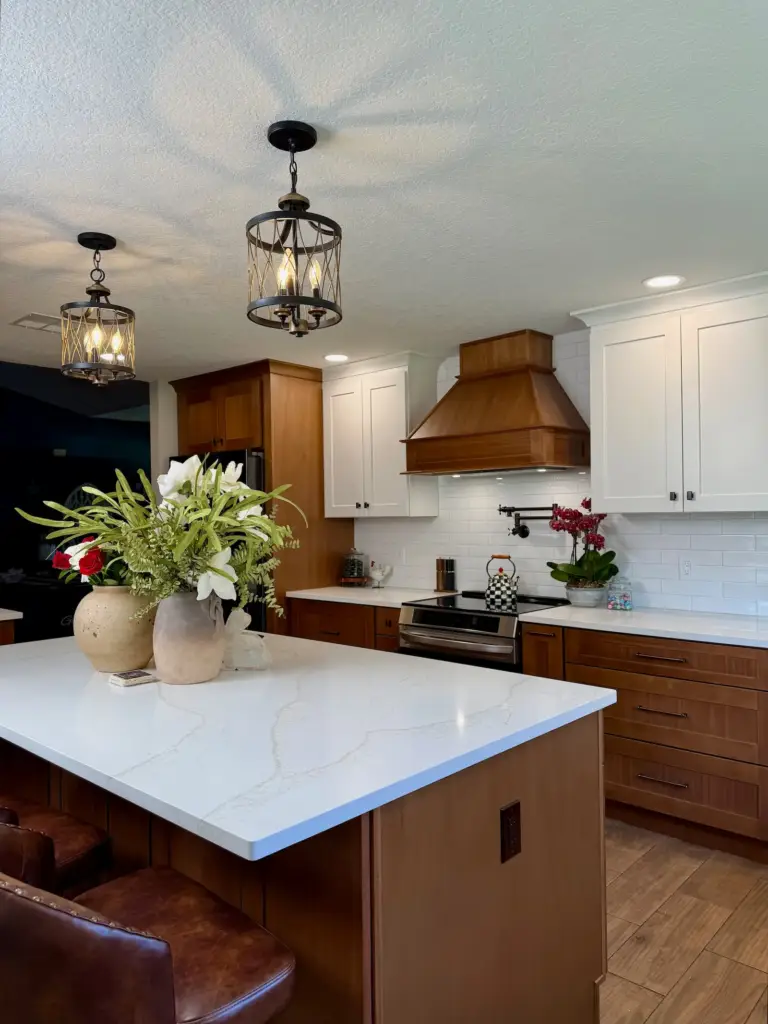
One note before we start: this post is about the finish on a slab you have already chosen. If you are still deciding on the material itself, start with our quartz vs. granite countertops comparison, then come back here.
The three countertop finishes explained
A finish is the surface treatment a fabricator gives the slab. It does not change the stone underneath. The same block of granite can be cut into three slabs and finished three ways, and they will look like three different materials.
- Polished. The stone is ground with progressively finer abrasives until it shines like glass. It is the most reflective finish and the one that shows the most color and depth in the pattern.
- Honed. The grinding stops before the final polishing steps, leaving a smooth, flat matte surface with little or no shine. It reads softer and more understated.
- Leathered. After honing, the slab is worked with diamond-tipped brushes that follow the natural softer spots in the stone. The result is a gently textured surface with a low sheen that feels a little like, well, leather.
Polished vs. honed vs. leathered at a glance
| Polished | Honed | Leathered | |
|---|---|---|---|
| Look | High gloss, reflective | Flat matte | Soft sheen, subtle texture |
| Color | Deepest, richest color | Lighter, more muted | Rich, close to polished on dark stones |
| Fingerprints and water spots | Shows them easily, especially on dark stone | Shows oily marks and smudges | Hides them best |
| Stain resistance | Best, pores are tightly closed | Lowest, most open surface | Good when properly sealed |
| Sealing | Least often | Most often | More often than polished |
| Everyday cleaning | Easiest, wipes in one pass | Easy, but marks linger | Wipe with the texture; crumbs can settle in |
| Glare under bright light | Most glare | None | Very little |
| Best stones | Any granite or quartzite | Lighter granites, marble, soapstone | Dark granites and many quartzites |
What is leathered granite?
Leathered granite is granite that has been honed and then brushed with diamond abrasives. The brushes wear down the softer minerals slightly more than the harder ones, so the surface ends up with tiny, natural undulations you can feel with your fingertips.
Nothing is carved or stamped in. The texture comes from the stone itself, which is why no two leathered slabs feel exactly alike.
Visually, it sits between the other two finishes. It keeps much of the color depth of a polished slab, especially on dark stones like black and deep brown granites, but without the mirror shine. In person, it looks warm and natural rather than showroom glossy.
Leathered granite pros
- Hides everyday marks. Fingerprints, water rings and smudges are far less visible than on polished stone. On a black countertop, that alone sells most homeowners.
- No glare. Pendant lights and sunlight do not bounce off it, which matters in bright, open kitchens.
- Keeps the color. Unlike honing, leathering does not wash out dark stones.
- Better grip. Pans and glasses slide less, and the surface feels good under your hands.
Leathered granite cons
- Crumbs and flour can settle into the texture. A soft cloth or brush moving with the surface takes care of it, but it is not a single swipe like polished stone.
- More open than polished. It needs to be sealed properly and resealed on schedule.
- Not every stone suits it. Some lighter granites look a little flat or uneven once leathered. Always look at a sample of your actual slab.
- Often an extra fabrication step. Many slabs arrive polished from the yard, so leathering can add time and cost. Ask for it to be priced separately.
Polished and honed finishes: where each one wins
Polished: the low-maintenance classic
Polished is still the most common finish for a reason. Grinding the stone to a high shine closes up its surface, so a polished slab is the most resistant to stains and the easiest to wipe clean. It also shows off dramatic veining and movement better than any other finish.
The trade-off is that everything shows: fingerprints on the island, spots around the sink, and streaks if you clean with the wrong product. On lighter, busy-patterned granites, those marks disappear into the stone. On solid dark colors, they do not.
Honed: the quiet, modern look
Honed stone has a calm, matte look that pairs beautifully with flat-panel cabinets, natural wood and a more relaxed style. It is also the traditional finish for marble, because honing makes the dull etch marks from lemon juice or wine much harder to spot than they are on a polished surface.
The downside is that honed is the most open of the three finishes. It absorbs more readily, needs sealing more often, and can show oily handprints until they are cleaned off. Honing also lightens dark stone noticeably, so a black granite can end up reading as charcoal.
Maintenance, sealing and daily life
All three finishes on natural granite need sealing. The difference is how often. Polished granite needs it least. Leathered and honed surfaces are more open, so plan on resealing them more often. The simplest way to know when it is time is the water test:
- Pour a small puddle of water on a few spots, including near the sink and the cooktop.
- Wait about 10 to 15 minutes.
- Wipe it away. If the stone underneath has darkened, it is absorbing water and is ready to be resealed.
For daily cleaning, the rules are the same for every finish: warm water with a mild dish soap or a pH-neutral stone cleaner, and a soft cloth. Skip vinegar, bleach and abrasive powders, which can wear down the sealer. On leathered granite, wipe in a couple of directions so the cloth reaches into the texture.
How each finish holds up in a Central Florida kitchen
Two local conditions are worth thinking about. First, light. Many Central Florida homes have large sliding doors, big windows onto the lanai and open floor plans, and strong afternoon sun turns a polished counter into a mirror. Honed and leathered finishes avoid that glare.
Second, water. Hard water is common across the region, and mineral spots dry white on dark polished stone. A leathered surface hides them far better, which is a big part of why it is so popular for kitchen islands and sink runs here.
Our humidity does not damage granite in any finish, and none of the three is harmed by normal Florida heat. What matters is the sealer, and that comes down to maintenance, not climate.
Which finish suits which kitchen
There is no single best finish. There is a best finish for your stone, your lighting and the way your household actually uses the kitchen. Here is how we usually guide homeowners:
- Choose polished if you love dramatic veining, want the lowest-maintenance surface, and your stone is light or busy enough to hide marks. It suits traditional and glam kitchens with high-gloss or painted cabinets.
- Choose honed if you want a soft, modern or farmhouse look, you are using marble or a lighter stone, and you do not mind sealing a little more often.
- Choose leathered granite if your stone is dark, your kitchen is bright, you have young kids or a busy household, or you simply never want to chase fingerprints again. It pairs especially well with warm wood, shaker cabinets and matte black or brass hardware.
Mixing finishes in one kitchen
You do not have to pick one. A popular approach is a polished island as the showpiece, where the pattern can shine, with leathered stone on the perimeter counters around the sink and cooktop, where the working mess happens.
Mixing works best when both finishes use the same stone or two stones from the same color family, so the change reads as a deliberate choice. It also helps to decide this during design, because the fabricator will finish each slab separately.
Always look at a real sample
Finish changes color and pattern more than most people expect. Before you commit, look at a sample of your chosen stone in each finish, in your own kitchen light, at different times of day.
Run your hand over the leathered piece, put a drop of water on each, and see which one you like living with. It is a small step that avoids the most common countertop regret.
Leathered granite and countertop finish FAQs
Is leathered granite hard to keep clean?
No. It needs the same mild soap and water as any granite. The only difference is that crumbs and flour can settle into the texture, so wipe it in more than one direction. In return, it shows far fewer fingerprints and water spots between cleanings.
Does leathered granite stain more easily than polished?
Its surface is more open than polished stone, so it can absorb oil or wine faster if the sealer has worn off. Kept properly sealed and wiped up promptly, it performs very well in a working kitchen.
Can quartz countertops be leathered?
Quartz is engineered, so its finish is set at the factory rather than brushed by a fabricator. Many brands offer matte or textured versions that imitate honed or leathered stone. Be aware that matte quartz tends to show metal marks and fingerprints more than polished quartz.
Can I change the finish on my existing countertops?
Sometimes. A stone restoration specialist can often hone a polished granite counter in place, or bring a dull honed surface back to a shine. Leathering is usually done at fabrication, before installation, so choose it while the slab is still at the shop.
Which countertop finish is best for a dark granite?
Leathered is usually the strongest choice. It keeps the deep color that honing tends to wash out, and it hides the fingerprints and water spots that show so clearly on dark polished stone.
Does the finish affect how long granite lasts?
Not really. Granite is extremely durable in every finish. The finish changes how the surface looks, feels and needs to be maintained, not the life span of the countertop.
Ready to start? Get a free estimate
Posada Remodeling & Design helps homeowners across Orlando, Winter Park, Longwood, Ocoee, Windermere and Lake Mary choose the right stone and the right finish as part of a complete kitchen remodel, and we bring samples so you can see them in your own light. We offer 0% financing so you can start your project now and pay over time.
All work is completed to the Florida Building Code. Compare materials in our quartz vs. granite countertops guide, see what a full project costs in our Central Florida kitchen remodel cost guide, browse finished countertops in the kitchen gallery, learn about our kitchen remodeling service, or get a free estimate.